What Is the Lord’s Supper?
For many Christians, the Lord’s Supper is one of the most familiar parts of worship. Bread is broken. The cup is shared. We hear Christ’s words from the night before His crucifixion: “Do this in remembrance of me” (Luke 22:19). Because the practice is so familiar, however, it can become easy to participate in Communion without thinking very much about what we are doing or why Jesus gave this meal to His church.
Christians have disagreed about the Lord’s Supper for centuries. Some traditions understand the bread and wine to become the body and blood of Christ. Others emphasize Communion primarily as a memorial in which Christians remember what Jesus accomplished on the cross. The Reformed tradition has historically taken a position between these understandings. The bread remains bread and the cup remains the cup, but the Lord’s Supper is more than an exercise in remembering something that happened long ago. Christ gives the meal to His church as a means by which He strengthens and nourishes the faith of His people.
To understand why, we have to begin where the Lord’s Supper began.
A Meal Given by Jesus
On the night before His crucifixion, Jesus gathered with His disciples to celebrate Passover. Matthew tells us, “As they were eating, Jesus took bread, and after blessing it broke it and gave it to the disciples, and said, ‘Take, eat; this is my body.’ And he took a cup, and when he had given thanks he gave it to them, saying, ‘Drink of it, all of you, for this is my blood of the covenant, which is poured out for many for the forgiveness of sins’” (Matthew 26:26–28).
Jesus was not choosing bread and wine in a vacuum. He was speaking during a meal already filled with meaning.
Passover recalled God’s deliverance of Israel from slavery in Egypt. According to Exodus 12, each Israelite household was to sacrifice a lamb and place its blood on the doorposts of the home. When judgment came upon Egypt, the houses marked by the blood were spared. Israel was delivered, and God commanded His people to remember that deliverance by observing Passover in generations to come.
Jesus takes this ancient meal of deliverance and places Himself at its center.
The bread is now associated with His body. The cup is associated with His blood, “poured out for many for the forgiveness of sins.” Soon afterward, Jesus will be arrested, condemned, crucified, and buried. What the disciples are about to witness is not simply the death of their teacher. Christ is giving Himself for His people.
The Lord’s Supper therefore points us toward the cross. Every celebration of Communion brings the church back to the heart of the gospel: Christ gave Himself for sinners.
“Do This in Remembrance of Me”
Paul gives the church an account of the Lord’s Supper in 1 Corinthians 11, repeating Christ’s command: “Do this in remembrance of me.”
Remembering is therefore essential to Communion. Yet biblical remembrance is richer than simply recalling a fact. When Israel celebrated Passover, the people were not merely being asked to remember that an interesting historical event had once occurred in Egypt. They were remembering the saving act of the God to whom they belonged. God’s past faithfulness shaped their present identity.
Something similar happens at the Lord’s Table.
We remember that Christ’s body was given for us. We remember that His blood was shed for the forgiveness of sins. We remember that our salvation rests upon His finished work rather than our own worthiness. That matters because Christians are forgetful (well, all people are).
We may know the gospel and still begin living as though our standing before God depends upon whether we have performed well enough this week. We may confess salvation by grace while quietly measuring ourselves by our successes and failures. We may carry guilt that Christ has already borne or place confidence in accomplishments that could never save us.
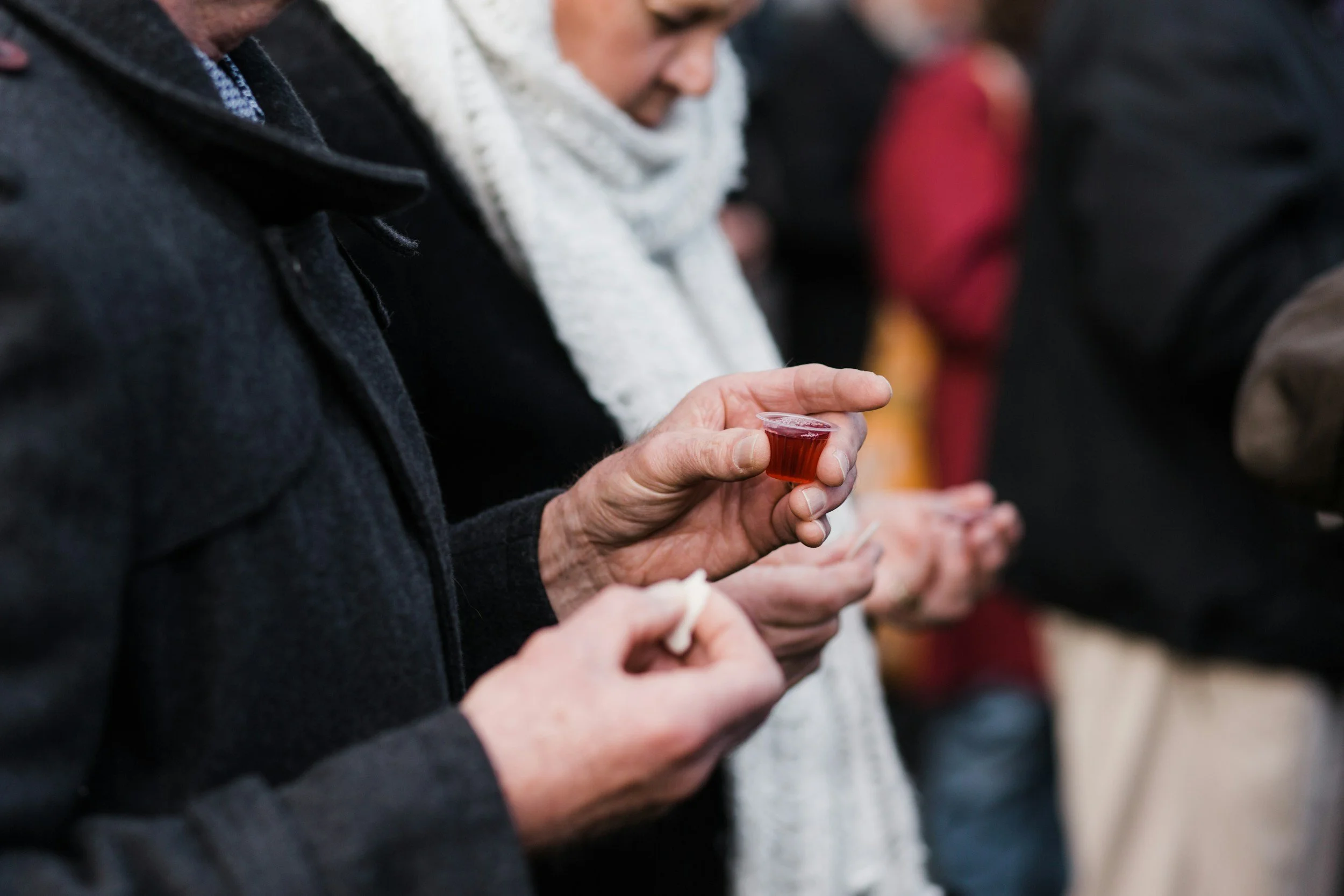
At the Table, the gospel becomes visible. Bread is broken. The cup is given. We receive rather than achieve. The physical simplicity of the meal points us again toward the simplicity of the promise: Christ has given Himself for His people.
More Than a Memorial
The Reformed tradition agrees that the Lord’s Supper is an act of remembrance, but it has historically resisted reducing Communion to remembrance alone. The Heidelberg Catechism asks how the Lord’s Supper reminds and assures Christians that they share in Christ’s sacrifice and benefits. Its answer points first to the visible actions of the meal. Just as surely as we see the bread broken and the cup given, we are assured that Christ’s body was offered and His blood poured out for us.
That word assured is important.
The sacraments do not add something missing from Christ’s saving work. Jesus does not need to be sacrificed again when Christians celebrate Communion. Hebrews emphasizes that Christ offered Himself “once for all” (Hebrews 10:10). His sacrifice is complete. Instead, the Lord’s Supper confirms the promise of the gospel to us.
The Reformers sometimes described the sacraments as visible signs of invisible grace. God knows that we are embodied creatures. He gives us His Word to hear, but in the sacraments He also gives us something we can see, touch, taste, and receive. The gospel says that Christ gave Himself for His people. At Communion, the minister places bread into our hands. The gospel says that Christ’s blood was shed for the forgiveness of sins.
At Communion, the cup is given to us. The sacrament does not replace the promise. It makes the promise visible.
Is Christ Present at the Table?
This question became one of the major controversies of the Reformation. The Roman Catholic Church taught that, in the Eucharist, the substance of the bread and wine becomes the substance of Christ’s body and blood. Some Protestants responded by understanding the Lord’s Supper primarily as a symbolic memorial.
The Reformed tradition rejected both explanations.
The bread and wine remain bread and wine. Christ’s physical body remains in heaven. Yet Reformed Christians have also insisted that Christ is genuinely present with His people at the Table through the Holy Spirit. This can sound mysterious because it is.
But mystery is not the same thing as meaninglessness. Christians already confess that the risen Christ is present with His church even though we cannot see Him physically. Jesus promises His disciples, “I am with you always, to the end of the age” (Matthew 28:20). The Holy Spirit joins believers to Christ and makes us participants in His life.
John Calvin therefore spoke about Communion as genuine spiritual nourishment. Just as ordinary bread nourishes the body, Christ nourishes the spiritual life of His people. The Belgic Confession similarly describes the Lord’s Supper as a spiritual table at which Christ communicates Himself and His benefits to believers. We do not receive Christ by physically eating His flesh. We receive Him through faith, by the work of the Holy Spirit.
This is why Communion can be described as a means of grace. God uses the ordinary elements of bread and the cup to strengthen faith in the extraordinary promise of Christ.
A Meal We Receive Together
There is another dimension of the Lord’s Supper that can be overlooked when we think about Communion only in terms of our individual relationship with God.
We do not normally celebrate it alone. Paul writes, “Because there is one bread, we who are many are one body, for we all partake of the one bread” (1 Corinthians 10:17). Communion points not only to our union with Christ but also to our belonging to His church. This becomes especially important in 1 Corinthians because the Corinthian church had managed to turn the Lord’s Supper into an occasion for division. Wealthier Christians were eating while poorer members of the congregation went without. Paul responds sharply because their behavior contradicted the very meal they were celebrating. They were proclaiming unity in Christ while behaving as though some members of Christ’s body mattered more than others.
The Lord’s Supper therefore asks us to look in more than one direction. We look back to Christ’s death. We look to Christ Himself, who nourishes His people. But we also look around the Table. The person receiving Communion beside us belongs to the same Christ. Differences of age, income, occupation, education, background, personality, and social status do not disappear when Christians enter the church. But none of them determines who receives the better place at Christ’s Table.
Everyone comes with empty hands. Everyone receives.
Why Examine Ourselves?
Paul’s warning in 1 Corinthians 11 also explains why many churches encourage self-examination before Communion. He writes, “Let a person examine himself, then, and so eat of the bread and drink of the cup” (verse 28).
That instruction can easily be misunderstood. Self-examination does not mean determining whether we have become good enough to receive Communion. If only Christians who had achieved sufficient holiness could come to the Table, the Table would remain empty.
The question is not whether we are sinners. We already know the answer. Instead, Communion calls us to come honestly. We recognize our sin, repent of it, trust Christ’s promise of forgiveness, and seek reconciliation where our sin has harmed others. We do not approach the Table claiming that we have no need of grace. We approach precisely because we do.
The Lord’s Supper is therefore not a reward handed to Christians for having an unusually successful spiritual week. It is nourishment for people who need Christ.
Communion Looks Forward
The Lord’s Supper points backward to the cross, but it also points forward.
After giving the cup to His disciples, Jesus tells them, “I will not drink again of this fruit of the vine until that day when I drink it new with you in my Father’s kingdom” (Matthew 26:29). Paul makes the same connection when he writes, “For as often as you eat this bread and drink the cup, you proclaim the Lord’s death until he comes” (1 Corinthians 11:26).
Those final words matter: until he comes. Every celebration of Communion takes place between two events. Christ has died and risen. Christ will come again. The church lives in between.
We gather at the Table while the world is still marked by sin, grief, illness, conflict, injustice, and death. We receive a small piece of bread and a cup while awaiting something much greater: the day when faith becomes sight and God’s people share fully in the joy of His kingdom. Scripture repeatedly uses the image of a feast to describe that future. Isaiah speaks of the Lord preparing “a feast of rich food” for all peoples on the day when He destroys death forever (Isaiah 25:6–8). Revelation describes “the marriage supper of the Lamb” (Revelation 19:9).
Communion is therefore both remembrance and anticipation. We remember the sacrifice that has already been made, and we await the feast that is still to come.
Coming to the Table
The Lord’s Supper is remarkably ordinary in appearance. There is bread. There is a cup. There are familiar words from Scripture, spoken again. Yet through those ordinary things, the church tells the story at the center of the Christian faith. Christ’s body was given. Christ’s blood was shed. Sinners are forgiven. Christ nourishes His people. The church is one body. And the risen Lord will come again.
We do not come to the Table because we have finally reached a point where we no longer need grace. We come because Christ knows that we do. He gives His church a meal that directs our attention away from our own spiritual performance and back toward Him.
“Take, eat.”
“Drink of it, all of you.”
The Christian faith begins with a gift, and at the Lord’s Table, once again, we open our hands and receive.